Our History
Origins of the National Volunteer Service
The National Volunteer Service Office (NVS) was formally established through an Act of Parliament, passed on 12 April 1990. This landmark legislation was introduced as a private member’s Bill by the late Honorable Bernard Narakobi, former Member for Wewak, whose vision was to institutionalize volunteerism as a national mechanism for development. The intent of Parliament in supporting and passing this Bill was clear: to ensure that basic services and government-led development initiatives reached all citizens of Papua New Guinea, regardless of their location or circumstances. At the time, Papua New Guinea faced significant challenges in service delivery. The government’s traditional systems were slow, stagnant, and often unable to translate policy into tangible outcomes that could alleviate poverty or improve socio-economic conditions. Many communities, particularly in rural and remote areas, were left without access to essential services. These realities prompted the government of the day to seek an innovative solution—one that would empower citizens to help one another and bridge the gaps in service delivery.
Purpose and Vision
Out of this policy environment, the National Volunteer Service was conceived as a vehicle to promote and support citizen participation in sustainable, people-centered development. The vision was to mobilize Papua New Guineans to serve their fellow citizens, fostering a spirit of sacrifice, solidarity, and national pride. By engaging volunteers, the Service aimed to complement government efforts, extend the reach of development programs, and ensure that communities themselves became active participants in shaping their future. The creation of NVS represented more than just a response to administrative inefficiencies—it was a bold recognition of the power of volunteerism to transform society. It sought to institutionalize the idea that development is not solely the responsibility of the state, but a shared endeavor in which every citizen can contribute. In this way, NVS became a cornerstone for building resilience, strengthening social cohesion, and advancing inclusive growth across Papua New Guinea.
Bernard Mullu Narokobi OBE was a Papua New Guinean politician, jurist, and
philosopher. He was serving as the Papua New Guinean High Commissioner to New
Zealand prior to his death. Between 1987 and 1997 he represented his Wewak Open
Electorate as a Member in the Papua New Guinea’s National Parliament.
Born: 1937, East Sepik Province
Died: 2010
Books: Two Seasons: A Novel, Foundations for Nationhood, Death of a Muruk: A Play, Leadership in PNG
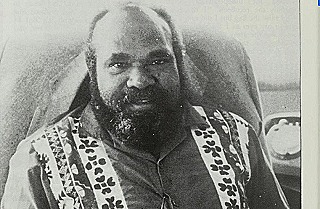
Bernard Mullu Narokobi
Founding Father for the National Volunteer Service
Core Values
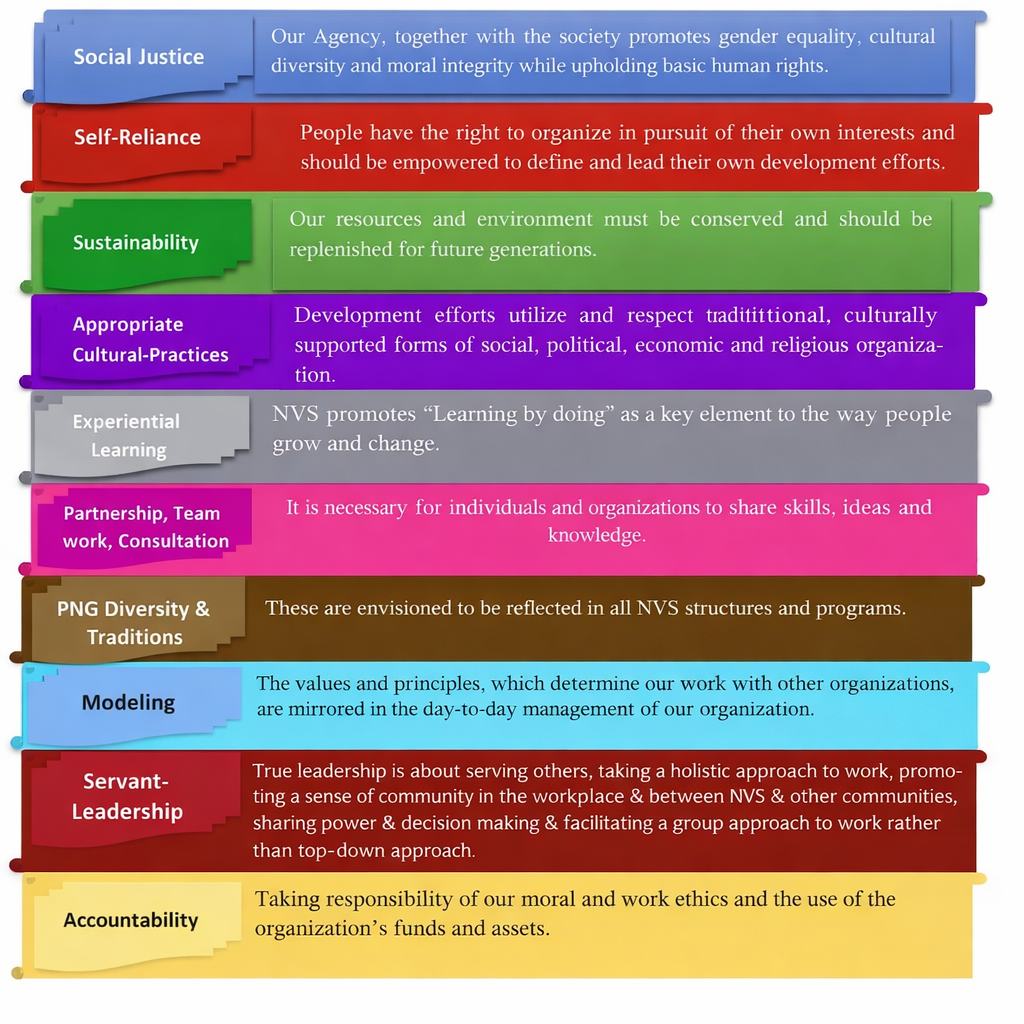
Role and Philosophy of the National Volunteer Service
The National Volunteer Service (NVS) operates not in competition or duplication of existing government structures, but in collaboration, filling critical gaps and extending the reach of the national service delivery mechanism.
NVS functions as:
- A facilitator
- A provider
- A participative collaborator
- A supportive network
It celebrates diversity across sectors and communities, with an approach rooted in people-centered development. Volunteerism is inclusive and responsive to the needs of Papua New Guinea’s varied social and cultural contexts.
The philosophy of volunteerism embraced by NVS is built on the values of sacrifice and service. These principles permeate its understanding and practice of community development, emphasizing integral human resource development. By nurturing skills, fostering civic responsibility, and encouraging active participation, NVS strengthens both individuals and communities, creating a foundation for sustainable national progress.
Legislative Mandate and Policy Framework
The National Volunteer Service is mandated by legislation, specifically the National Volunteer Service Act of 1990, which provides the legal foundation for its operations.
Its work is further guided by policy frameworks, including:
- The earlier White Paper Policy on Community Development
- The National Policy on Professional Volunteerism (NPPV) 2020–2025
These policies define NVS’s role in managing and coordinating volunteer programs and services across Papua New Guinea.
NVS is also obligated to deliver on several of the National Government’s macro policies, aligning its programs with long-term national visions and strategies:
- Vision 2050 – particularly Pillar 5 on Institutional Development and Service Delivery
- Development Strategic Plan (DSP) 2010–2030
- Medium Term Development Plan III (MTDP III), contributing to Key Result Areas (KRAs):
- KRA 1: Increased Revenue and Wealth Creation
- KRA 2: Quality Infrastructure
- KRA 3: Sustainable Social Development
- KRA 5: Improved Service Delivery
- KRA 6: Improved Governance
- KRA 7: Responsible Sustainable Development
Through this alignment, NVS ensures that volunteerism is not only a grassroots movement but also a strategic instrument of national development, directly supporting Papua New Guinea’s long-term aspirations.
- KRA 1: Increased Revenue and Wealth Creation
- KRA 2: Quality Infrastructure
- KRA 3: Sustainable Social Development
- KRA 5: Improved Service Delivery
- KRA 6: Improved Governance
- KRA 7: Responsible Sustainable Development